Why Rainbow Loop Adds Instant Whimsy to Your Designs
There’s a particular challenge in design work where you need to evoke genuine emotion without looking overly polished or corporate. You want something that feels handcrafted, perhaps a little bit retro, but definitely modern. That is exactly where Rainbow Loop enters the conversation. This isn’t just another script font; it is a distinct typeface that bridges the gap between playful nostalgia and contemporary graphic design. If you have been searching for a creative font that feels approachable and energetic, you have likely found your match.
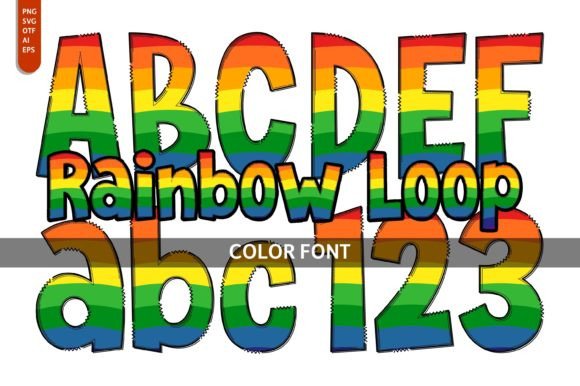
The Visual Personality of Rainbow Loop
At its core, Rainbow Loop is a display font that prioritizes movement. Unlike a standard serif font or a rigid sans serif font, this typeface mimics the organic flow of a marker or a smooth pen. The defining characteristic is its continuous, looping structure. The strokes often connect in a way that feels like a single, fluid motion. This gives the typography a sense of velocity and joy. It avoids the messy look of some handwritten fonts, offering a cleaner aesthetic that remains legible even at smaller sizes.
The personality of Rainbow Loop is undeniably friendly. It speaks the language of warmth and invitation. However, it does so with a stylistic flair that prevents it from looking childish or amateurish. The letterforms have a consistent weight and a balanced x-height, which anchors the text visually. It is a premium font in the sense that it has been engineered to look effortless while maintaining high technical standards. Whether you are working on a logo design or a quick social media post, the visual style remains consistent and engaging.
Where Rainbow Loop Truly Shines
Understanding where a font works best is just as important as liking how it looks. Rainbow Loop excels in environments where you need to grab attention quickly and convey a positive vibe. Because it is a display font, it is naturally suited for headlines and titles. Think about the cover of a children’s book or the header of a birthday invitation. In these contexts, the font does the heavy lifting of setting the tone before the reader even processes the words.
For entrepreneurs and small business owners, this typeface is a powerful tool for packaging design. Imagine a coffee bag, a candle label, or a box of artisan chocolates. Using Rainbow Loop for the product name adds an artisanal touch that suggests care and creativity. It signals to the customer that the product inside is crafted with personality. Similarly, in editorial design, such as magazine headers or blog graphics, the font breaks up the monotony of standard body text, providing a visual "pop" that guides the reader's eye.
Digital spaces are also a strong suit. Web designers can use Rainbow Loop for landing page hero text to create an immediate emotional connection. Content creators and marketers will find it invaluable for social media graphics. In a fast-scrolling environment, a bold, looping script font stands out against the noise. It works beautifully for quotes, announcements, and call-to-action buttons where you want to feel approachable rather than commanding.
Strategic Use: Brand Perception and Engagement
Typography is rarely just about decoration; it is a strategic asset. The fonts you choose tell a story about your brand identity. When you integrate Rainbow Loop into your visual language, you are making a specific statement. You are telling your audience that your brand is creative, accessible, and perhaps a little bit fun. This is particularly effective for brands targeting families, creative industries, or lifestyle markets.
However, the influence of a font extends to readability and hierarchy. Rainbow Loop is designed to be a focal point. It creates a clear visual hierarchy by drawing the eye to the most important information first. This is crucial for marketing materials where you have seconds to make an impression. If used correctly, it enhances engagement because people are naturally drawn to aesthetically pleasing, rhythmic shapes.
There is a nuance to professionalism here. While a playful font might seem risky for a serious business, using it as an accent—perhaps for a tagline or a specific campaign—can humanize a brand. It shows that behind the business, there are real people who value creativity. The key is consistency. Once you adopt Rainbow Loop for a specific element, maintaining that usage across your platforms builds recognition.
Practical Guidance for Implementation
Adopting a new typeface requires some practical consideration. Before you commit Rainbow Loop to a massive print run or a full website overhaul, you need to evaluate the fit.
Font Pairing is Essential
Rainbow Loop is a high-character font. It has a lot of personality. Therefore, pairing it with another highly stylized font can create visual chaos. The best practice is to pair it with something neutral. A clean sans serif font like Helvetica, Roboto, or Open Sans makes an excellent partner. The simplicity of the sans serif allows Rainbow Loop to stand out without competing for attention. This combination ensures that your body text remains readable while your headlines pop.
Readability and Size
Because of its looping nature, Rainbow Loop is not intended for long paragraphs of body copy. It is a creative font meant for short bursts of text. Use it for headers, sub-headers, and call-outs. When testing the font, try viewing it at the actual size it will appear in your project. Ensure that the loops in the letters don't close up or look like blobs at smaller resolutions. Generally, keeping it at a medium to large size preserves its artistic integrity.
Licensing and Formats
If you are working on a commercial project, always verify the licensing. A premium font usually comes with a license that covers specific uses, such as digital ads or physical merchandise. Ensure you have the correct file formats—OTF or TTF for desktop use, and WOFF or WOFF2 for web design. Checking these details upfront saves you from legal headaches later.
Real-World Scenarios for Rainbow Loop
To visualize how this works, consider a few specific scenarios. A blogger writing about DIY crafts could use Rainbow Loop for the title of their post to give it a handmade feel. A marketing team launching a summer sale could use the font on their email headers to convey excitement and urgency without using aggressive, sales-heavy language. A crafter designing greeting cards could use Rainbow Loop for the sentiment inside, ensuring the message feels personal and heartfelt.
Ultimately, Rainbow Loop is a versatile tool in your design assets library. It is a typeface that doesn't just sit there; it performs. It brings energy to a layout and warmth to a message. By understanding its personality and applying it strategically, you can elevate your projects from standard to memorable. Add it to your toolkit, experiment with the pairings, and watch how it transforms the feel of your work. You will likely find it becomes a go-to solution whenever a project needs a touch of joy.